Articles
S51(1) of the BELA Act requires that parents that want to educate their children at home must "...must apply to the Head of Department for the registration of the learner to receive home education". The requirement effectively converts parental liberty into a state licensing system. Many parents feel that it is their right to decide on the education of their children and that it is unacceptable that they must ask for permission to choose home education.
Considering this issue from the perspective of international law, the constitution and religious rights, there is indeed a strong case for parental rights.
International law
Parental rights have a long history in Western society. In 1690, the British philosopher John Locke articulated this as follows : "... Adam and Eve, and after them all parents were, by the law of nature, under an obligation to preserve, nourish, and educate the children they had begotten; not as their own workmanship, but the workmanship of their own maker, the Almighty, to whom they were to be accountable for them ...".
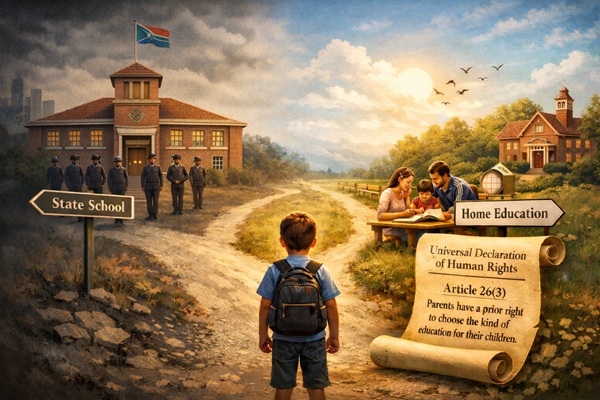
In 1948, the United Nations adopted the Universal Declaration of Human Rights (UDHR). S26(3) of this declaration states that "Parents have a prior right to choose the kind of education that shall be given to their children." This provision was adopted in the aftermath of the Second World War, when the international community had witnessed how governments could use state-controlled education systems to shape the beliefs and loyalties of the next generation. In Nazi Germany, home education was banned and schooling was placed under strict state control for ideological purposes. South Africa followed a similar approach during the apartheid era, when home education was prohibited. Article 26(3) therefore affirms an important principle of international human rights law: while the state may regulate education and ensure minimum standards, the primary authority and responsibility for directing a child’s education rests with parents, not the government.
In December 1966, the UN General Assembly adopted two international treaties that would further shape international human rights: the International Covenant on Economic Social and Cultural Rights (ICESCR), and the International Covenant on Civil and Political Rights (ICCPR). South Africa ratified both these treaties.
S13(3) of the ICESCR requires that states must "... undertake to have respect for the liberty of parents and, when applicable, legal guardians to choose for their children schools, other than those established by the public authorities, which conform to such minimum educational standards as may be laid down or approved by the State and to ensure the religious and moral education of their children in conformity with their own convictions."
Furthermore S18(4) of the ICCPR requires that states must "... undertake to have respect for the liberty of parents and, when applicable, legal guardians to ensure the religious and moral education of their children in conformity with their own convictions."
History shows that attempts by governments to claim exclusive authority over education have often been rejected by constitutional courts. In the landmark case Pierce v. Society of Sisters (1925), the Supreme Court of the United States struck down a law that required all children to attend public schools. The court held that “the child is not the mere creature of the State” and affirmed that parents have the right and duty to direct the upbringing and education of their children.
The Constitution
S39 of the Constitution states that "When interpreting the Bill of Rights, a court, tribunal or forum - ... (b) must consider international law; ...". This means that the South African government is also obligated to respect the liberty of parents, as required in the ICESCR and the ICCPR. The BELA Act requirements that parents must get state permission to choose home education does not respect this liberty of parents.
Furthermore, S28 of the Constitution states that : "Every child has the right- to family care or parental care, or to appropriate alternative care when removed from the family environment; ...". The definition of "care" is not provided the constitution, but the Children’s Act does provide such a definition that includes "... guiding, directing and securing the child’s education and upbringing, including religious and cultural education and upbringing, in a manner appropriate to the child’s age, maturity and stage of development;". If parents must ask state permission for home education, it infringes on the child's right to parental care.
Families, schools, churches and governments are different institutions in society, each with its own responsibilities. The upbringing and education of children belong primarily to the family. When the state requires parents to obtain permission before educating their children at home, it effectively claims authority within the family itself. This raises a deeper constitutional question: whether government officials have jurisdiction over decisions that belong to parents.
The same principle is also recognised by S81 (i)(iii) the Constitution of the Western Cape which requires that the provincial government must achieve "(i) an environment in which all children — (iii) receive basic education under a system of their parents’ choice;"
The state has a legitimate role in education only when there is evidence that parents are not able to make decisions that are in the best interest of their children anymore. In such cases the Children’s Act makes provision for the intervention by the upper guardian of the child.
Upper Guardian of the child
According to S45(4) of the Children's Act, the high court is the upper guardian. Only the upper guardian of the child has the authority to set aside parental decisions. The S51 of the BELA Act gives education officials the power to set aside the decision of parents to choose home education. Administrative officials should not have broad discretionary powers to override parental educational decisions without judicial oversight. Especially not if the registration requirements are vague and open to subjective interpretation.
According to the constitution, the best interests of children are of paramount importance. Parents are ordinarily best placed to assess the educational needs and interests of their own children. It is not reasonable that officials that are not best placed to determine the best interests of children need to approve parental decisions.
This also applies to teachers in schools. They also do not have such authority. There is the old saying that teachers act "in loco parentis", meaning they act in the place of the parents.
Religious nature of education
Since education is very much about the transfer of values, it intricately part of religion. There is no such thing as neutral education that has nothing to do with religion. The National Curriculum Statement in South Africa is based on the Interfaith religion that treats religion as a mere human activity and treats all religions as equal. Such a view is not compatible with a religion that views God as a sovereign being that is above all human institutions. This was a reason why many churches objected to the introduction of the National Curriculum Statement in 2002.
When the state determines the content and skills of education, then this infringes on the freedom of religion. This is the case when schools compel learners to be exposed to content that is not aligned to the convictions of parents or when the BELA Act prescribes the content and skills of home education.
Conclusion
International law and South African constitutional principles recognise that parents have the primary responsibility for directing their children’s education. While the state may set appropriate educational standards, converting parental educational choice into a licensing system risks undermining this foundational liberty.
Unfortunately the standards that the state sets for home education are based on collective measures for schools and are inappropriate for individualized forms of education.
Events
Has no connect to show!
Legal & Research
Homeschooling and the law
Home schooling was recognized in 1996 in Section 51 of the SA Schools
+ ViewCentres
Homeschool ABC
Videos

SAHomeschoolers.Org Youtube Channel
Support




Curriculums



Frequently Asked Questions
-
What is home education or homeschooling?
Home education is the oldest form of education. The school system as we know it is actually fairly new. It is done under the guidance and the...
-
Do home learners get homework?
In general all their schoolwork is homework and they do not get to do extra work in the afternoons. A tutor might give some extra work to complete...
-
Do home learners sometimes wish they were in school and were normal?
They generally like being homeschooled. Some homelearners go to school for the experience but many return to homeschooling as within the homeschool...
-
Do I need to be a qualified teacher?
No. Research has found no correlation between the qualification of the parent and the academic performance of the child. Research shows that...