Articles
Many parents choose home education because they want to focus on their children’s learning without unnecessary conflict with education officials. For this reason, some parents decide to register for home education in order to avoid problems.
However, it is important to understand that registration itself can carry risks.
Why do parents say registration can be risky?
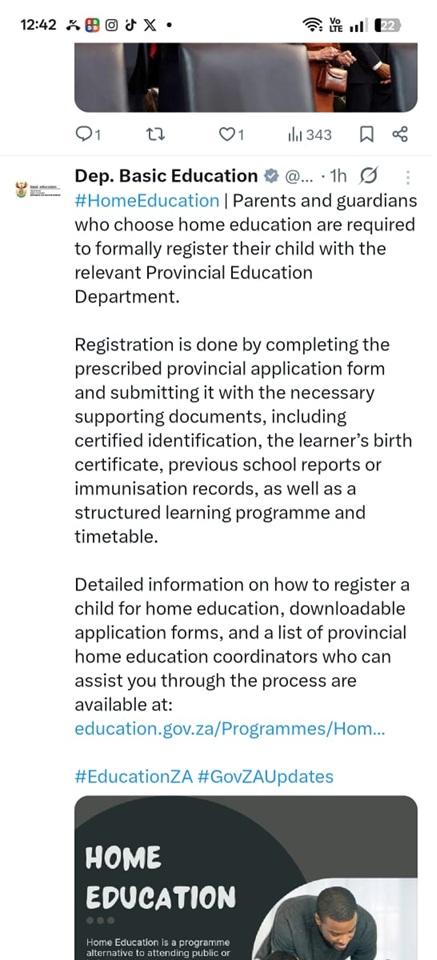
A recent example illustrates this clearly. The Department of Basic Education (DBE) published a post on X (formerly Twitter) stating that parents must submit supporting documents such as:
- Birth certificates
- Previous school reports
- Immunisation records
- A structured learning programme
- A timetable
Although the post was later removed after strong public response from home educators, it provides insight into the expectations that many officials may have when processing home-education applications.
Isn’t it normal for government to ask for documents?
There is an important legal inconsistency.
Section 5(1A) of the BELA Act states that a learner may not be refused admission to a school if required documents are not provided. In other words, school learners must still be admitted even if documentation is missing.
Home-education parents, however, are expected to provide extensive supporting documents as a condition for registration.
This results in unequal treatment between school learners and home learners, even though both are exercising the same constitutional right to basic education.
Why are the listed documents problematic for many families?
Many home-education families cannot reasonably comply with these expectations:
- Some families choose home education for health reasons and do not have immunisation records.
- Many parents follow flexible, child-led or needs-based learning approaches rather than fixed structured programmes.
- Some learners require time to recover from traumatic school experiences and need a period of deschooling before any curriculum can be finalised.
- Many families reject rigid timetables because children learn at different paces.
These realities are normal in home education but are often misunderstood by officials who apply school-based assumptions to family-based education.
Are there other concerns with the registration process?
Yes. The current application form requires parents to classify themselves and their children by race. Many parents who believe in non-racialism experience this as a moral and ethical problem.
What does the removed DBE post tell us?
Although the DBE post was removed, it highlights a serious concern: many officials do not have a proper understanding of home education or of how the law should be applied to it. This lack of understanding increases the risk of conflict, delays, rejections, or unfair treatment during the registration process.
Does this mean parents should not register?
Each family must make its own informed decision. Some families may still choose to register for personal, legal, or practical reasons.
The important point is that parents should understand the risks, expectations, and possible consequences before attempting to register — rather than discovering them only after conflict arises.
How can parents make an informed decision?
Parents who want guidance can book a personalised, one-on-one online consultation designed to help them begin home education with confidence and clarity:
These sessions help parents understand their legal position, educational options, and practical risks so that they can make informed and confident choices.
Events
Has no connect to show!
Legal & Research
Homeschooling and the law
Home schooling was recognized in 1996 in Section 51 of the SA Schools
+ ViewCentres
Homeschool ABC
Videos

SAHomeschoolers.Org Youtube Channel
Support




Curriculums




Frequently Asked Questions
-
Where can I find homeschool support groups?
There are many support groups consisting of parents that do things together and help each other. These groups operate on Facebook, mailing lists and...
-
Is home education often used as a smoke screen to hide child neglect?
State interference in home education is often justified as something that can identify situations where home education is used as a smoke screen to...
-
What is home education or homeschooling?
Home education is the oldest form of education. The school system as we know it is actually fairly new. It is done under the guidance and the...
-
Do home learners get homework?
In general all their schoolwork is homework and they do not get to do extra work in the afternoons. A tutor might give some extra work to complete...