fbpx

 Online schools have grown rapidly over the last decades. Especially during the pandemic they played a crucial role in ensuring that thousands of learners could continue with their education from home. The state had little choice but to allow these online schools to offer their services, since the physical schools were closed. After the pandemic the growth of online schools continued.

For families who rely on online education, this raises an important question: are parents allowed to make use of online schools, or could they unknowingly fall outside the requirements of South Africa’s education laws?

The uncertainty arises because South Africa’s education laws were written at a time when schooling almost always took place in physical classrooms. Online education does not fit neatly into this framework. As a result, the legal system struggles to determine how online schools should be regulated.

The Constitution

Section 29(3) of the South African Constitution recognises the right to establish independent educational institutions. It states : "Everyone has the right to establish and maintain, at their own expense, independent educational institutions that- (a) do not discriminate on the basis of race; (b) are registered with the state; and (c) maintain standards that are not inferior to standards at comparable public educational institutions." Given this one would expect that online schools must be registered with the state and their standards monitored.

The SA Schools Act

S46(4) of the South African Schools Act states that "No person may establish or maintain an independent school unless it is registered by the Head of Department." In South Africa, education is funded by the national department and administered by the provincial department. This means the online schools must be registered by the provincial Head of Department. However, the learners and teachers of online schools are not limited to one province. They are not even limited to South Africa. Without clarity on where online schools must register, this is difficult.


Provincial Regulations

Let’s say an online school limits its operations to the Western Cape, and wants to register in terms of the regulations on independent school in the province. The list below gives a number of requirements it must meet:

  • S2(1)(c) of the Western Cape regulations require the "The school buildings and grounds must offer the space, design and facilities which conform to standards ...".
  • Furthermore S2(2)(c) requires that "The Head of Department must determine the maximum number of learners who may be admitted to such an independent school on the basis of the school buildings and grounds referred to in subregulation ...".
  • Independent schools are required to "... keep a record of the registration of all employees with the South African Revenue Service and the Unemployment Insurance Fund;"

Since online schools do not use buildings to provide education, have no inherent limitation on the number of learners, and may employ staff across the world, meeting such requirements is challenging.

Accreditation with Umalusi

Independent schools must also be accredited with Umalusi. Some accreditation requirements that must be met are described in a guide published by Umalusi.

  • An Independent School must be registered with the Provincial Education Department prior to seeking accreditation with Umalusi.” The above paragraph explains why registration with the province is challenging. An online school that is not registered with a province cannot apply for accreditation with Umalusi.
  • Just like provincial registration, the accreditation is linked to the premises and the capacity of the school, which is not applicable to online schools.
  • The grades for which accreditation is sought must lead to the National Senior Certificate.” This makes it difficult for online schools that offer curriculums other than the state curriculum to be accredited.

Accreditation with Umalusi will therefore be even more challenging for online schools than registration with provincial departments.

Accreditation with SACAI and IEB

Many online schools are registered with SACAI or the IEB examination boards. In turn, the examination boards are accredited with Umalusi. It must be noted that this registration only applies to the issuing of the National Senior Certificate (NSC), which is valid for Grade 10 to 12. The examination boards have their own exam centres. Learners from online schools then write their exams at these examination boards. They also oversee that calculation of school based assessment scores. The registration with an examination enables the learners of online schools to obtain and NSC qualification, but does not mean that the online schools are registered.

However, online schools that offer qualifications other than the NSC, such as Cambridge or GED do not need to register with these examination boards. Schools offering Cambridge or GED often operate under different accreditation frameworks.

Are online schools legal in South Africa?

The constitution does not restrict independent educational institutions to physical schools only. Therefore online schools are not prohibited by the constitution.

Another difficulty arises from the fact that the Constitution protects the right to establish independent educational institutions without specifying how education must be delivered. Historically this took place in physical classrooms, but modern technology allows education to be delivered online. Laws that were designed for physical schools therefore struggle to accommodate new forms of education. From a constitutional perspective, regulation should focus on the educational activity itself rather than the technology used to deliver it.

The current legal framework was designed for physical schools and does not clearly accommodate online schools. If the state were to prohibit online schools entirely, it would likely conflict with the constitutional protection of independent educational institutions. There would therefore be strong grounds to challenge any attempts by the state to outlaw online schools.

Unfortunately the state seems unwilling to accommodate online schools. The BELA Bill was the first major revision of the Schools Act since 1996. When the BELA Bill was considered by parliament, there were a number of submissions, including one from the Human Rights Commission, that requested that this opportunity must be used to make provision for online schools. It would have been perfectly reasonable if parliament sent the BELA Bill back to the DBE and request the inclusion of online schools. Parliament however failed to do this, causing online schools to operate in a gray area for even longer.

Because online schools are not prohibited by the constitution, the state cannot arbitrarily prohibit a legitimate form of education, but it may regulate it with appropriate regulations.

Especially in the light of parliament that failed to respond to a request to regularise online schools. While the legal framework is unclear, there is currently no explicit prohibition on parents making use of online education services.

The way forward

On 6 January 2026 an EFF MP asked the minister on the status of online schools and the answer was as follows: “The DBE obtained a legal opinion from OCSLA advising that the South African Schools Act, 1996 should be amended to include online schools. Work is underway to develop proposed amendments to the South African Schools Act, 1996 to include online schools, as well as interim measures to guide the sector in how best to address existing online schools.” In response to this, SAHomeschoolers wrote to the DBE for a copy of the legal opinion and any interim measures contemplated.

It is not expected that anything will happen soon. The previous BELA Bill took more than 10 years from when drafting started until it was enacted. Furthermore, it can be expected that teachers unions will oppose the recognition of online schools, because it threatens job security of teachers at physical schools.

Is an online school a school?

Some might argue that an online school should not be viewed as a school, but merely as the provider of educational resources. Such institutions do not need to register as schools.

There are however a number of reasons why this is not preferable:

  • The definition of a school in the Schools Act is that it :”… enrols learners in one or more grades from grade R (Reception) to grade twelve;” If an online school enrols learners in a grade, it will be difficult to argue that it is not a school.
  • It might restrict the use of online schools to parents that educate their children at home and will exclude many learning centres and small schools that provide partial care to children as well as access to online schools.

It is important that online schools are regulated in a way that provides education to the broadest group of people, and not in a way that it protects the vested interests of specific groups.

Should home learners that use online school register for home education?

Some online schools encourage parents to register learners for home education in terms of S51 of the SA Schools Act. Parents should consider the following:

  • According to S3(1) of the SA Schools Act " ... every parent must cause every learner for whom he or she is responsible to attend school ...". As explained in the previous section, it is reasonable to view an online school as a school. Parents that have enrolled learners in an online school have therefore complied with this requirement.
  • In its definitions the SA Schools Act states that home education "... may include tutorial or other educational support, if necessary, secured by the parent on specific areas of the curriculum followed by the learner;..." This wording suggests that learners registered for home education may only make use of tutorial support in specific areas of the curriculum, rather than following a full institutional programme. This might not be in the best interest of the learner.
  • It must be noted that registration for home education is only required for Grades R to 9. No registration is required for Grades 10 to 12.

The legal position is therefore unclear. Some online schools encourage parents to register for home education, while others argue that learners enrolled in online schools are already attending a form of school. Until the law is clarified, parents should carefully consider the implications of each approach.

Conclusion

The rapid growth of online education has exposed a gap in South Africa’s education law. The regulatory framework governing independent schools was designed for physical institutions with buildings, classrooms and geographically defined learners. Online education does not fit this model. As a result, many online schools operate in a regulatory grey area. While the Constitution protects the right to establish independent educational institutions, the practical mechanisms for recognising online schools remain unclear. Until the law is updated, uncertainty will remain for both providers and families.


S51(1) of the BELA Act requires that parents that want to educate their children at home must "...must apply to the Head of Department for the registration of the learner to receive home education". The requirement effectively converts parental liberty into a state licensing system. Many parents feel that it is their right to decide on the education of their children and that it is unacceptable that they must ask for permission to choose home education.

Considering this issue from the perspective of international law, the constitution and religious rights, there is indeed a strong case for parental rights.

International law

Parental rights have a long history in Western society. In 1690, the British philosopher John Locke articulated this as follows : "... Adam and Eve, and after them all parents were, by the law of nature, under an obligation to preserve, nourish, and educate the children they had begotten; not as their own workmanship, but the workmanship of their own maker, the Almighty, to whom they were to be accountable for them ...".

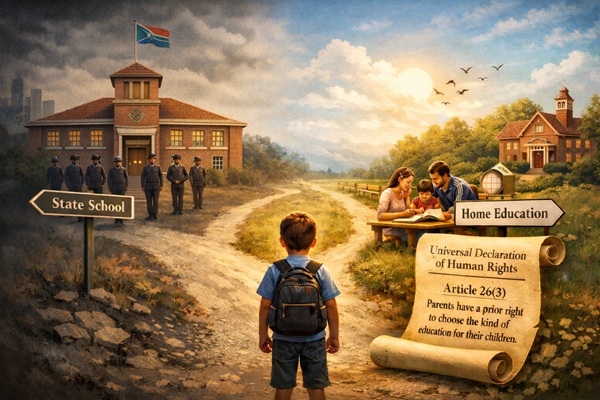
In 1948, the United Nations adopted the Universal Declaration of Human Rights (UDHR). S26(3) of this declaration states that "Parents have a prior right to choose the kind of education that shall be given to their children." This provision was adopted in the aftermath of the Second World War, when the international community had witnessed how governments could use state-controlled education systems to shape the beliefs and loyalties of the next generation. In Nazi Germany, home education was banned and schooling was placed under strict state control for ideological purposes. South Africa followed a similar approach during the apartheid era, when home education was prohibited. Article 26(3) therefore affirms an important principle of international human rights law: while the state may regulate education and ensure minimum standards, the primary authority and responsibility for directing a child’s education rests with parents, not the government.

In December 1966, the UN General Assembly adopted two international treaties that would further shape international human rights: the International Covenant on Economic Social and Cultural Rights (ICESCR), and the International Covenant on Civil and Political Rights (ICCPR). South Africa ratified both these treaties.

S13(3) of the ICESCR requires that states must "... undertake to have respect for the liberty of parents and, when applicable, legal guardians to choose for their children schools, other than those established by the public authorities, which conform to such minimum educational standards as may be laid down or approved by the State and to ensure the religious and moral education of their children in conformity with their own convictions."

Furthermore S18(4) of the ICCPR requires that states must "... undertake to have respect for the liberty of parents and, when applicable, legal guardians to ensure the religious and moral education of their children in conformity with their own convictions."

History shows that attempts by governments to claim exclusive authority over education have often been rejected by constitutional courts. In the landmark case Pierce v. Society of Sisters (1925), the Supreme Court of the United States struck down a law that required all children to attend public schools. The court held that “the child is not the mere creature of the State” and affirmed that parents have the right and duty to direct the upbringing and education of their children.

The Constitution

S39 of the Constitution states that "When interpreting the Bill of Rights, a court, tribunal or forum - ... (b) must consider international law; ...". This means that the South African government is also obligated to respect the liberty of parents, as required in the ICESCR and the ICCPR. The BELA Act requirements that parents must get state permission to choose home education does not respect this liberty of parents.

Furthermore, S28 of the Constitution states that : "Every child has the right- to family care or parental care, or to appropriate alternative care when removed from the family environment; ...". The definition of "care" is not provided the constitution, but the Children’s Act does provide such a definition that includes "... guiding, directing and securing the child’s education and upbringing, including religious and cultural education and upbringing, in a manner appropriate to the child’s age, maturity and stage of development;". If parents must ask state permission for home education, it infringes on the child's right to parental care.

Families, schools, churches and governments are different institutions in society, each with its own responsibilities. The upbringing and education of children belong primarily to the family. When the state requires parents to obtain permission before educating their children at home, it effectively claims authority within the family itself. This raises a deeper constitutional question: whether government officials have jurisdiction over decisions that belong to parents.

The same principle is also recognised by S81 (i)(iii) the Constitution of the Western Cape which requires that the provincial government must achieve "(i) an environment in which all children — (iii) receive basic education under a system of their parents’ choice;"

The state has a legitimate role in education only when there is evidence that parents are not able to make decisions that are in the best interest of their children anymore. In such cases the Children’s Act makes provision for the intervention by the upper guardian of the child.

Upper Guardian of the child

According to S45(4) of the Children's Act, the high court is the upper guardian. Only the upper guardian of the child has the authority to set aside parental decisions. The S51 of the BELA Act gives education officials the power to set aside the decision of parents to choose home education. Administrative officials should not have broad discretionary powers to override parental educational decisions without judicial oversight. Especially not if the registration requirements are vague and open to subjective interpretation.

According to the constitution, the best interests of children are of paramount importance. Parents are ordinarily best placed to assess the educational needs and interests of their own children. It is not reasonable that officials that are not best placed to determine the best interests of children need to approve parental decisions.

This also applies to teachers in schools. They also do not have such authority. There is the old saying that teachers act "in loco parentis", meaning they act in the place of the parents.

Religious nature of education

Since education is very much about the transfer of values, it intricately part of religion. There is no such thing as neutral education that has nothing to do with religion. The National Curriculum Statement in South Africa is based on the Interfaith religion that treats religion as a mere human activity and treats all religions as equal. Such a view is not compatible with a religion that views God as a sovereign being that is above all human institutions. This was a reason why many churches objected to the introduction of the National Curriculum Statement in 2002.

When the state determines the content and skills of education, then this infringes on the freedom of religion. This is the case when schools compel learners to be exposed to content that is not aligned to the convictions of parents or when the BELA Act prescribes the content and skills of home education.

Conclusion

International law and South African constitutional principles recognise that parents have the primary responsibility for directing their children’s education. While the state may set appropriate educational standards, converting parental educational choice into a licensing system risks undermining this foundational liberty.

Unfortunately the standards that the state sets for home education are based on collective measures for schools and are inappropriate for individualized forms of education.

This opinion considers whether, under section 51 of the Basic Education Laws Amendment Act (“the BELA Act”), parents who provide home education may freely choose an educational curriculum.

It examines the interaction between sections 51(2)(b)(i) and 51(2)(a)(iii), the scope of administrative discretion conferred on provincial authorities, and the implications of vagueness for both administrative approval and criminal enforcement.

Statutory framework

Section 51(2)(b)(i) of the BELA Act requires parents to undertake to: “make suitable educational resources available to support the learner’s learning.

Section 51(2)(a)(iii) requires that the Head of Department (“HOD”) be satisfied that: “the proposed home education programme is suitable for the learner’s age, grade level and ability and predominantly covers the acquisition of content and skills at least comparable to the relevant national curriculum determined by the Minister.

Parental choice of curriculum is therefore subject to approval based on both learner suitability and national curriculum comparability.

Constitutional principles engaged

The provisions under consideration engage several foundational constitutional principles, including:

  1. The principle of legality and the rule of law (section 1(c));
  2. The right to lawful, reasonable, and procedurally fair administrative action (section 33);
  3. The best interests of the child (section 28(2));
  4. Freedom of conscience, belief, and opinion (section 15), insofar as curriculum choice reflects philosophical or pedagogical convictions;
  5. Parental responsibility and care, as recognised in constitutional jurisprudence relating to family autonomy.

Any statutory scheme that limits parental decision-making in education must therefore be sufficiently clear, rational, and proportionate to withstand constitutional scrutiny.

Vagueness and the principle of legality

The requirement that a home education programme must “predominantly” cover content and skills “at least comparable” to the national curriculum is undefined and indeterminate.

The Act does not specify:

  1. What degree of alignment constitutes “predominant” coverage;
  2. How “comparability” is to be measured;
  3. Which elements of the national curriculum are essential or non-essential;
  4. How alternative pedagogical approaches are to be assessed.

The Constitutional Court has consistently held that laws imposing obligations on citizens must be stated with sufficient clarity to enable compliance. Vague laws undermine the principle of legality, a core component of the rule of law.

Where compliance depends on the subjective satisfaction of an official without objective criteria, affected persons cannot reasonably predict the legal consequences of their actions. In this context, parents cannot determine in advance whether their chosen curriculum will be approved, despite acting in good faith.

Subordination of parental judgment and the best interests of the child

Section 51(2)(b)(i) recognises parental responsibility to select resources suitable for the learner. However, section 51(2)(a)(iii) effectively redefines suitability through alignment with the national curriculum.

This creates a structural tension:

  • Individual learner needs, abilities, and educational contexts may justify a curriculum that diverges from the national model;
  • Yet approval hinges on national curriculum comparability, irrespective of demonstrated educational benefit to the learner.

Section 28(2) of the Constitution provides that the best interests of the child are of paramount importance in every matter concerning the child. Home education is inherently individualized, and parental decisions regarding curriculum are often motivated by the specific educational needs of a child.

A statutory framework that prioritises systemic curricular conformity over individualized educational suitability risks elevating administrative convenience above the best interests of the learner. At minimum, the Act provides no guidance on how these interests are to be balanced.

Administrative discretion and constitutional administrative justice

The broad discretion afforded to HODs by section 51(2)(a)(iii), in the absence of objective standards, raises concerns under section 33 of the Constitution.

  • Unstructured discretion creates a material risk of:
  • Inconsistent decision-making across provinces;
  • Arbitrary or subjective refusals;
  • Unequal treatment of similarly situated parents.

Administrative justice requires that decisions be capable of rational justification and meaningful review. Where the statutory test itself is undefined, both decision-makers and reviewing courts lack a principled basis on which to assess compliance.

This undermines transparency, accountability, and fairness in the registration process.

Criminal enforcement, fault, and “just cause”

Failure to register a home learner constitutes a criminal offence, subject to a defence where parents have a “just cause” for non-registration.

Criminal liability requires that obligations be clear and ascertainable. Where registration depends on uncertain approval criteria and unpredictable administrative discretion, parents may reasonably be deterred from applying, particularly where rejection could expose them to further regulatory consequences.

In any prosecution, the state must prove beyond reasonable doubt that the accused lacked just cause. Given the vagueness of the curriculum approval requirement, and the absence of objective compliance standards, establishing the absence of just cause would be evidentially challenging, especially where parents acted bona fide in the educational interests of their children.

Conclusion

It is the considered opinion that section 51 of the BELA Act materially restricts curriculum choice for home educators through vague and undefined approval requirements tied to the national curriculum.

These provisions engage and potentially undermine constitutional principles of legality, legal certainty, administrative justice, and the best interests of the child. The absence of objective standards creates scope for arbitrary administrative action and weakens the enforceability of criminal sanctions for non-registration.

Unless clarified through precise regulations or authoritative guidance, section 51 is likely to generate legal uncertainty, deter lawful compliance, and invite constitutional challenge.

On 11 December 2025, the Department of Basic Education (DBE) published a circular on home education. This circular was directed to Education Officials, District Managers, School Principals and the Home Education Community. This circular was distributed to the National Task Team (NTT) responsible for drafting home education regulations on 24 February 2026.

This is the third circular on home education. Circulars published this far are the following:

  • Circular S14 of 2020 : Home Education in the context of Covid-19
  • Circular S15 of 2022 : Home Education registration within the context of online schools
  • Circular S24 of 2025 : Guidance on Home Education Curriculum and Assessment. Click here to download.

What is the status a circular?

A circular is not a law that is binding on the public. However it is an instruction that is binding on officials and they are likely to apply the interpretation contained in the circular when exercising their administrative functions.

If parents do not agree with the interpretation provided with the circular, it will result in conflict between parents and officials. This has already happened when the KZN Education Department declined applications on the basis of Circular S15 of 2022, because officials viewed the education programme chosen by parents as an online school.

The guidance provided by S24 of 2025 is temporary in nature, until regulations are published.

What does Circular S24 say?

The circular provides guidance on two matters:

  • How to determine whether curriculums are predominantly comparable with the national curriculum as required by S51(2)(a)(iii) of the BELA Act.
  • How to determine a standard that is not inferior to the standard determined in the national curriculum statement.

Curriculum

Enforcement of the S51 curriculum requirement is difficult to enforce, because it is vague and it contradicts other sections in S51. Read article here.

The aim of this circular is to provide more clarity on the curriculum requirement. It proposes that curriculums are compared by considering the following factors:

  • Age appropriate and grade-appropriate learning: An important reason why many parents choose home education is because it allows learners to progress at their own pace according to the development of their personality. Age / Grade appropriate learning will require that the contents that learners must master is determined by their age or grade, irrespective of the personal development or ability. A rigid interpretation of age- or grade-appropriate learning risks undermining the flexibility inherent in home education and may conflict with the constitutional requirement that administrative decisions serve the best interests of the child.

  • Progressive acquisition of knowledge and skills … alligned with the broad aims of the national curriculum: The National Curriculum Statement (NCS) documents state that it “aims to produce learners that are able to …” and then it lists things such as creative thinking, problem solving, etc. Things that few people will disagree with. Although there is nothing objectionable to this clarification, it is of little value to clarify how curriculums be compared.

  • Exposure to broad learning fields : The NCS describes subjects, instructional time to be allocated to each subject, number of assessments per term, contents and skills. The circular states that the educational programme must provide exposure to broad learning fields recognised in the National Curriculum. How “broad learning fields” can be mapped to the NCS is however not described. The introduction of new undefined concepts such as “broad learning fields” risks expanding statutory requirements beyond what Parliament enacted.

  • Meaning of “comparable” : The circular further states that the word “comparable” does not mean identical content or structure, but requires the consideration of engagement with broad learning fields, progressive development and a coherent educational experience with suitable depth and breadth. This process introduces even more undefined concepts and provides no guidance on how these concepts are to be used for comparison purposes. Such a process is likely complex and susceptible to subjective judgments.

  • Evidence for comparison : The circular then lists different types of evidence that parents can provide to demonstrate curriculum comparability. Parents can choose what type of evidence they want to provide in order to enable officials to perform curriculum comparisons. However, the evidence chosen parents might not be useful to officials for comparison purposes.

Assessment

The BELA Act requires that home learners must be assessed "against a standard that is not inferior to the standard determined in the National Curriculum Statement". However S29(3)(c) requires that independent education institutions must "maintain standards that are not inferior to standards at comparable public educational institutions". This means home learners are evaluated against a theoretical standard in the NCS, while independent schools are evaluated against standards of actual public schools. This means that different standards apply to home learners than to independent schools. The distinction raises questions about whether the evaluation framework for home education is administratively proportionate compared to other recognised forms of alternative education.

This is further complicated because the standard maintained at an independent school is a collective concept, which cannot logically apply to individualised home-based learning. (Read more here) This raises questions about whether applying institution-based standards to individualised home education is constitutionally appropriate and proportionate.

Compliance can be obtained by providing a diverse types of evidence. This evidence must be evaluated by a competent assessor as defined in the BELA Act. The assessor must determine whether the standard of education is not inferior by considering things such as undefined concepts such as meaningful learning, progression across fields, development of core competencies and broad alignment with phase-end expectations of the NCS. Such an evaluation is complex and susceptible to subjective judgments.

To find assessors that can use the diverse forms of evidence to determine the standard of education received will probably be difficult for competent assessors that do not have an understanding of home education. Competent assessors are trained to assess against the clearly defined NCS and not the undefined concepts in the circular. This is exacerbated by the exclusion by the BELA Act definition of professionals such as educational psychologists and other therapists that are registered with the Health Professional Council as competent assessors.

A recent survey highlighted the reality that a large percentage of parents that applied for registration were not registered. The Act does however exempt unregistered learners from the obligation to submit end of phase assessments. However, if a learner is not registered, it will not be possible to process the assessment reports, because the capturing of the assessment results should be linked to the registration number of the learner. The circular does not address this matter. It assumes a functioning registration system that does not yet exist in practice.

The circular places no obligations on officials to process the assessment reports. If the processing of assessment reports does not result in remedial actions, the assessments do not serve any reasonable purpose. Even in provinces where the majority of applications are timeously processed, there is probably not administrative capacity to process assessment reports and take remedial actions if needed.

Furthermore, according to S51(2)(b)(ii), parents must undertake to "monitor the learner’s academic progress". For parents that diligently honor this undertaking, a end-of-phase assessment will merely confirm what the parents already know. For parents who already fulfil statutory monitoring responsibilities, mandatory external assessments may provide limited additional educational value relative to their cost and administrative burden.

Conclusion

The circular will probably increase conflict between officials and parents for the following reasons:

  • Parents have limited certainty that officials will regard their curriculum as comparable with the NCS due to the vague and subjective comparison process.
  • Parents have little certainty what the outcome of assessments will be, given their complex and subjective nature.
  • While parents already lack certainty that registration applications are processed timeously, they have even less certainty that assessment reports will be processed. What exacerbates this is that parents are expected to pay for competent assessors, while officials might not even process assessment reports.
  • Even if assessment reports are processed, parents have no certainty what officials will do with the results. Will they offer remedial services or cancel registrations?

Although it will still take a while before the regulations are published, the circular provides some insight into what the DBE wants in the regulations. This allows parents to prepare for when the regulations are published for public comment.

Although public engagement during the BELA process did not substantially change the wording of the Act, Circular S24 suggests an effort by the DBE to reassure home educators that flexibility in curriculum choice and assessment methods remains possible. At the same time, this flexibility introduces complex comparison processes that may place significant administrative burdens on the Department itself.

The issues raised by Circular S24 highlight the importance of continued public engagement during the development of the home education regulations. Clear, objective and proportionate regulatory standards will be essential to avoid unnecessary conflict and to ensure that administrative discretion is exercised consistently and fairly.

In 2017, it was estimated that there were about 100 000 home learners in South Africa. This estimate took into account the national census of 2012, the membership of home education organisations, the household survey and the school population. The article on this is available at https://www.sahomeschoolers.org/blog-items/entry/how-many-home-learners-are-there-in-south-africa.html

International trends, particularly from the United States, suggest homeschooling can grow at around 10% annually. While South African conditions differ, anecdotal evidence from local curriculum providers suggests comparable growth. One summary of U.S. homeschooling trends, for example, can be viewed at https://babwell.com/homeschooling/

Based on this growth, it is estimated that home learners grow to about 121 000 in 2019. Such a growth seems realistic, because some curriculum providers reported higher growth than this.

During the pandemic, homeschool organisations such the Pestalozzi Trust and also the HSLDA in the USA experienced a doubling of membership in 2020. If it is assumed that this reflects the growth of home education, it brings the number to 242 000 in 2020. However, as children returned to school in 2021, it was conservatively estimated that home education declined with 10% to 217 800 learners. After this, it was estimated that home education continued to grow at 10% annually again giving 289 891 by 2024.

In December 2023, the Learning Society Institute published a peer reviewed report on home education by Dr Renuka Ramroop from the University of Limpopo. This report provides the first research-based insights into the demographics of home education. This report estimates the number of home learners to be about 300 000, which correlates well with the above estimates.

South Africa has roughly 13 million school-aged learners (based on national education statistics), this would place homeschooling at just over 2% of the total learner population.

This report also gives an estimate of the provincial breakdown, based on the number of responses received.

Province Percentage
Limpopo 5,0%
Gauteng 27,5%
North West 6,3%
Mpumalangq 8,2%
Western Cape 24,2%
Eastern Cape 5,2%
Free State 14,2%
KZN 6,7%
Northern Cape 2,7%

Because these figures are based on voluntary survey participation, provinces with stronger homeschool networks or internet access may be overrepresented. If populations are considered, it seems that Free State is over represented and KZN under represented.

While earlier figures were based on projections and assumptions, they align closely with the first formal research findings — and with the lived experience of homeschooling’s rapid normalization across South African society. More than a decade ago, people would have asked what it is if home education was mentioned. Today, most people will respond by stating that they know a friend or family member that is homeschooling.

These projections cover learners that receive education at home. There are indications that a growing number of learners also attend so-called learning centres, tutor centres and cottage schools — small, often informal educational initiatives that operate outside the traditional school system.

Both home education and informal centres will increasingly be empowered by online learning platforms becoming more advanced and prevalent. Together, home education and learning centres suggest that education in South Africa is gradually diversifying. Rather than a single dominant model, the future may consist of a spectrum of educational forms — from formal schools on one end, through small community-based centres, to fully home-based education on the other.

Current education law recognises public schools, independent schools and home education, but does not clearly accommodate the growing diversity of hybrid and informal learning models. While the Constitution requires independent educational institutions to register with the state, many emerging education models do not fit neatly into the existing legal categories, creating regulatory uncertainty for home educators and learning centres.

Because the legal framework was designed around traditional schooling models and was only recently amended, significant regulatory reform in the near future may be unlikely. SAHomeschoolers provides regulatory advisory and advocacy services that assists parents and centres to educate children in a safe environment.


Events

Has no connect to show!

Legal & Research

Research on Home Education

Research on home education consistently proves that home learners

+ View

Homeschooling and the law

Home schooling was recognized in 1996 in Section 51 of the SA Schools

+ View

History of homeschooling in SA

History of home education in South Africa (Wikipedia article)

+ View

Centres

EduComply Services

EduComply offers a practical, step-by-step support system that helps

+ View

Learning centre overview

Homeschool, micro-school, learning centre, unregistered private

+ View

Start a Learning Centre

Important considerations when starting a learning centre

+ View

Find a learning centre

There are various ways to find learning centres. Since there is

+ View

Homeschool ABC

A

Approaches

Popular homeschooling approaches and styles ...

+ View
B

Beginning

4 Easy steps to start homeschooling ...

+ View
C

Curriculum

How to choose a curriculum for your family ...

+ View

Videos

SAHomeschoolers.Org Youtube Channel

Support

Homeschool Family blogs

Blogs by homeschooling families that share their experiences and ...

Tutors

Tutors provide additional support to homeschooling parents. ... ...

Support Groups

Forums where parents and learners discuss issues with each other and ...

Assessment Tools

Assessment - Choose What Works for Your Family Parents can now ...

Curriculums

Elroi Academy (Gr 8 - 12)

Elroi Academy – Top-Rated Distance Education Provider in South ...

Cambricollege

Achieve More with Cambricollege Cambricollege offers flexible, ...

A.C.E (Gr R - 12)

The A.C.E. programme is uniquely suited to home education, ...

Beit HaSefer

  Tailor made Home Education by Beit HaSefer (No ‘one size fits ...

Frequently Asked Questions

If you
  • Prev
  • Curriculums & Resources